Overview
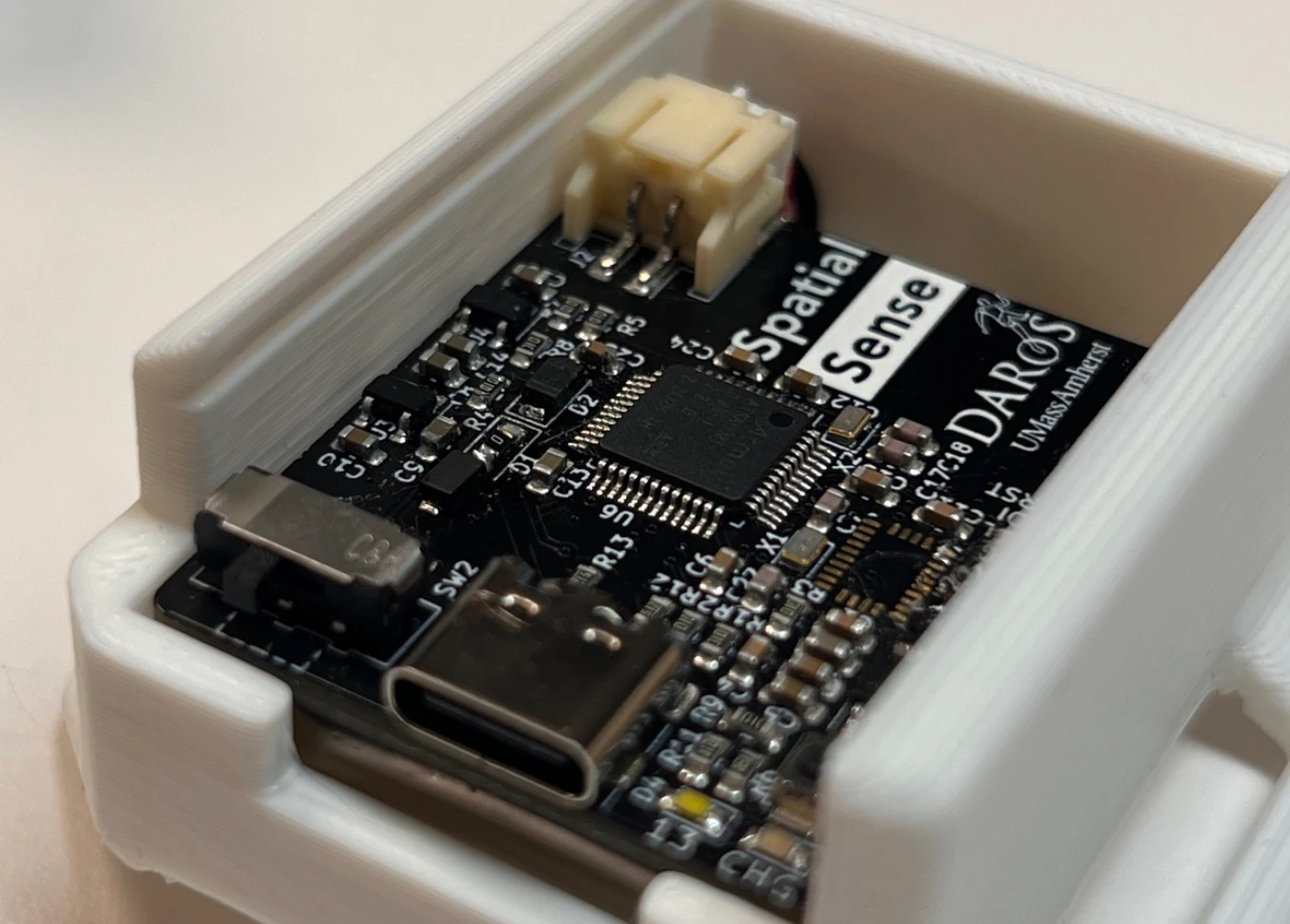
SpatialSense is a full-body wireless motion tracking system with integrated haptic feedback, designed around ultra-low-latency communication. The system uses multiple IMUs distributed across the body to capture motion data in real time, and the nodes communicate with one another in real-time.
The haptic feedback component allows for bidirectional communication: the system can not only track motion but also provide tactile feedback based on external events or interactions. Each unit is incredibly small and battery-powered, measuring 1.5" × 1".
The system was used for a research project at the DARoS Lab at UMass Amherst in 2023, for ETH Zurich's Cybathlon Vision Assistance Race. A visually impaired research participant needed to move around a room with haptic feedback indicating events determined by the position of a tray they were holding.
Hardware
The main hardware components are:
- IMU: Bosch BNO055 9-axis IMU with an integrated microcontroller for sensor fusion
- 915 MHz packet radio: Ultra-low-latency RFM69HCW with AES-encrypted packets
- LRA vibration motors: Vybronics LRAs with a high-bandwidth TI DRV2605L driver
- Battery management system: Onboard BMS, voltage regulator, and LiPo charging
- Microcontroller: ATSAMD21G18 for sensor I/O, radio, and haptic control
Each sensor node is compact and battery-powered, allowing for untethered full-body motion capture.
Many different components and approaches were investigated during the initial system design. Because the project needed to be delivered under short time constraints, the PCB had to work on the first try. To that end, many integrated components were used. For example, the Bosch BNO085 contains an integrated ARM Cortex-M0 that automatically computes 3D orientation, so the primary microcontroller does not have to run the sensor-fusion math itself (and accumulate compounding error).
Rather than using an impedance-controlled PCB manufacturing process, an off-the-shelf tuned antenna was chosen for 915 MHz. A high-impulse linear resonant actuator (LRA) from Vybronics was chosen for haptic feedback, driven by a high-bandwidth closed-loop controller from Texas Instruments (DRV2605L) tuned to its resonant frequency.
To keep wireless latency low between nodes, 915 MHz packet radio was chosen over software-heavy alternatives like Wi-Fi or Bluetooth. The main software overhead on this interface is AES encryption and decryption of each packet. Measured latency between nodes was about 2 ms.