Overview
Personal projects are incredibly important to an early engineer's growth. This is especially true in Electrical Engineering, where the financial barrier to entry is low, and there is a passionate community of makers sharing resources online. Completing a project, from start to finish, teaches a multitude of skills - and most importantly, it helps develop a systems engineering mindset early on. For me, the very spirit of making and being creative is at the heart of EE. When I realized in my sophomore year at WPI that most EE students didn't have personal projects or build things outside of class, I wanted to help them develop those foundational skills.
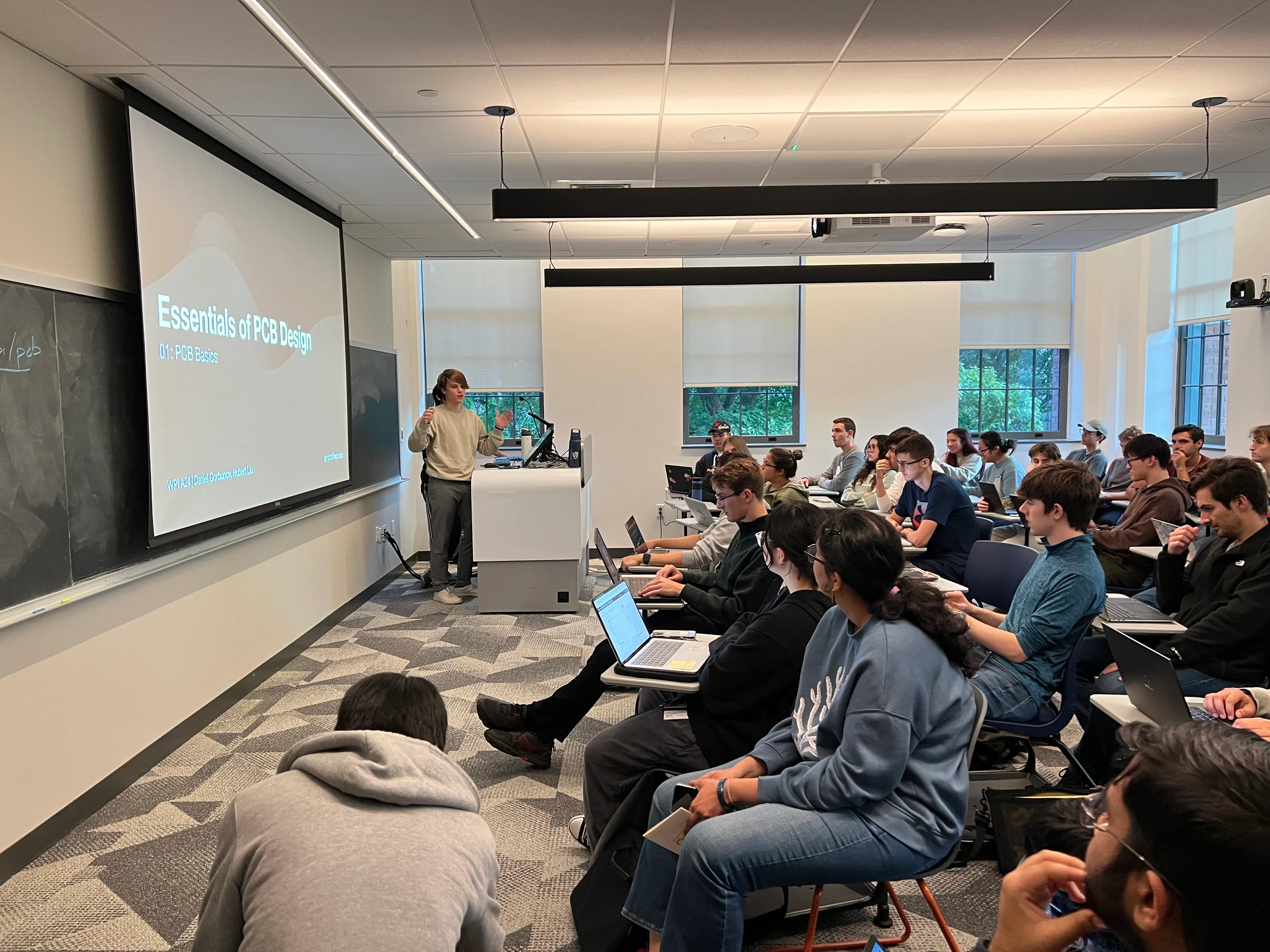
To address this, I created a comprehensive printed circuit board (PCB) design course at WPI, with the goal of teaching students the skills they need to design and build their own electronics projects. The course takes students, many who have never built a personal project before, through designing and assembling their own PCBs, covering both the theory and practical skills needed for modern electronics design.
The course is organized as a four-part evening lecture series, and with nearly 200 students in its most recent offering, it's become the largest class (by enrollment) at WPI! The lectures cover many topics, from physical aspects of PCBs, to project research and design through a systems engineering lens, to layout and routing considerations. In the fourth lecture, students are guided through using KiCad to add basic components to their boards.
Two tracks are offered in the course: In the first track, which is the most popular, students are given a working schematic for a board with a microcontroller and addressable RGB LEDs, and are free to add on their own peripherals. In the second track, students are free to design any PCB they want, and we order it. Students are given two to three weeks, usually coinciding with a term break, to design their own PCB. Office hours are hosted frequently by course TAs and instructors. Once a student completes their design and is signed off by a TA, their PCB is ordered. Once we receive all the boards, assembly sessions are held for students.
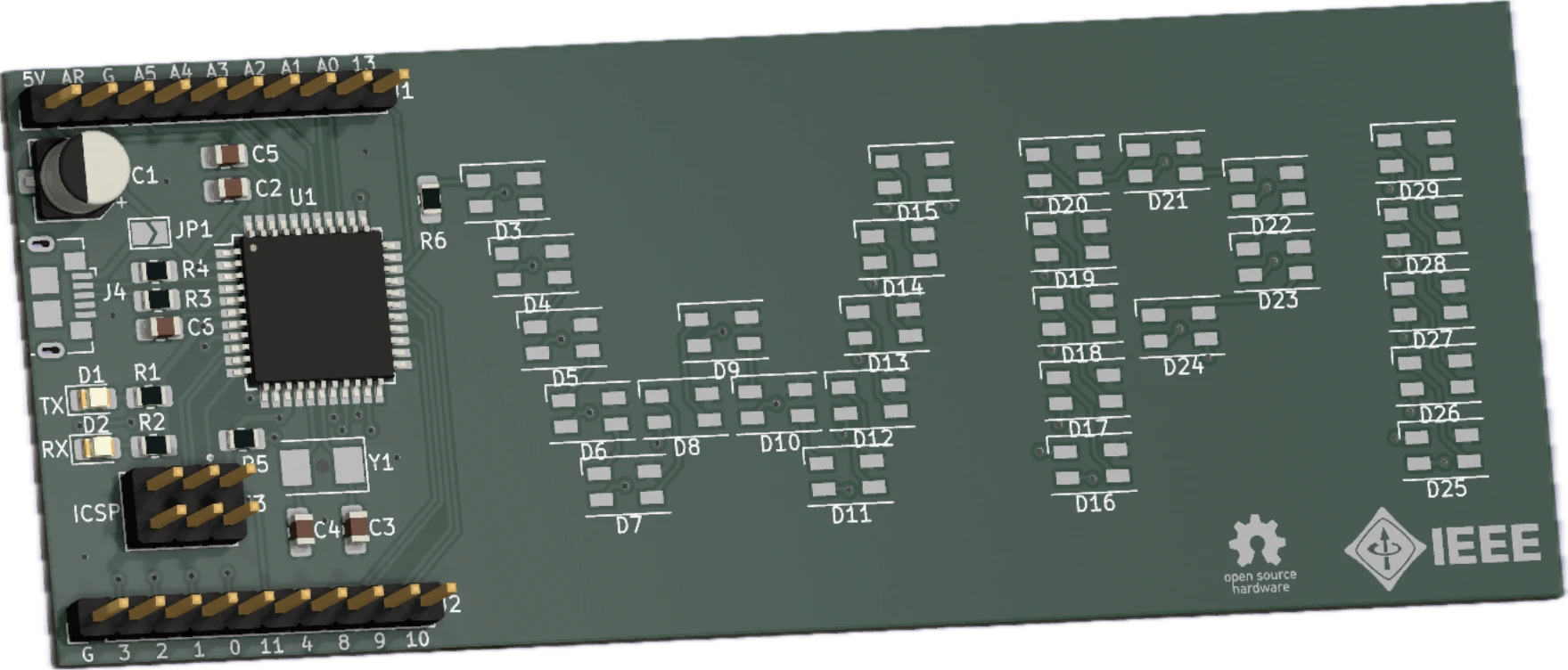
In the assembly sessions, students populate their boards using components we have purchased for them. We heavily promote the use of surface mount (SMT) components in the course — and all of the components on the Track 1 boards are SMT. For many of these students, they are learning to solder SMT components for the first time. For others, it may be their first time soldering at all! After placing all their components on their boards, students insert their boards into a reflow oven.
The course is run usually every semester through WPI's IEEE Student Branch, where I served on the executive board of for two years. The IEEE branch helps the course allocate the large amount of funding needed to purchase student boards and components. I first taught the course in D-Term (March) of 2023, and continued teaching it every semester until I graduated in 2026.
Website
The course website hosts all the materials for the course, including lecture slides, starter board files, and recordings from each session. Note that you must sign in with a WPI account to view lecture recordings due to WPI IT policy.
Lectures
The course lectures are as follows:
-
Introduction to PCB Design. The physical aspects of PCBs are discussed and terminology introduced, along with the design and manufacturing process.
-
Project Design. Several projects are discussed as case studies through a systems engineering lens.
-
Layout + Routing. Layout design and routing methodologies are discussed in detail.
-
KiCad Practice. An overview of KiCad is given and schematic capture, layout, and routing are practiced.