Overview
University rankings lean heavily on research output and reputation, and largely don't include teaching quality as a metric. In 2022, about 15.4 million undergraduates were enrolled at U.S. degree-granting institutions, compared to just 3.2 million graduate students. Teaching is the core of most of these undergraduate programs, yet rankings still treat it as an afterthought, leaning on proxies like student-faculty ratios and reputation surveys that say little about what actually happens in a classroom.
At the same time, rising tuition and increasingly selective admissions have made higher education feel more exclusive. Course materials often stay locked behind walls meant for paying students, so prospective students and the public get little real insight into teaching. Universities spend large amounts marketing themselves, but rarely open up course syllabi and other materials, which would significantly increase the transparency of their programs.
Open Educational Resources (OER) offer a way out of this. When MIT launched OpenCourseWare in 2001, it showed that freely sharing syllabi, lecture materials, and exams could expand access while strengthening an institution's global reputation. Other schools have since experimented with partial open access and platforms like edX and Coursera, but faculty still face real barriers: intellectual property worries, fair reuse concerns, and the time it takes to prepare materials for public release.
Luckily, WPI is a great fit for OER adoption. Its project-based, hands-on curriculum is distinctive, and initiatives like the Global Projects Program push its reach globally. Still, its recognition remains largely regional. Sharing course materials publicly would give prospective students a clearer picture of WPI's pedagogy and help the school reach a wider audience. Surveys conducted with students indicated broad interest in distributing course materials online, specifically to aid in course registration. Surveys with faculty found willingness to share select materials, as long as they kept control over what was published and who could see it.
I wanted to make a platform that made it as easy as possible for WPI faculty to share course materials online. Luckily, WPI was already using Canvas to host course materials. By integrating my platform with Canvas, I could streamline course material publishing by using existing documents on Canvas without requiring faculty to upload new documents. As the most popular LMS for higher education in the US, Canvas was a great choice that also made my platform easier to adopt for other universities.
Our mission is to make higher education more accessible by creating a platform that empowers faculty to easily share their course syllabi. WPI has always focused on global impact through it's Global Projects Program, and this platform furthers that mission.
Timeline
I started the project in the Fall of 2024 as my Interactive Qualifying Project (IQP), a junior-year research project all WPI undergraduates complete. I worked closely with multiple administrative departments and the Dean of Undergraduate Studies to create a platform that the school would adopt. While the initial version of the site allowed faculty to upload all their course materials from Canvas, concerns around IP led to the decision to only host syllabi on the site. I continued development of the site until the Spring of 2026. The university plans to adopt the platform for faculty in the 2026-2027 academic year. The site lives at openlearning.wpi.edu.
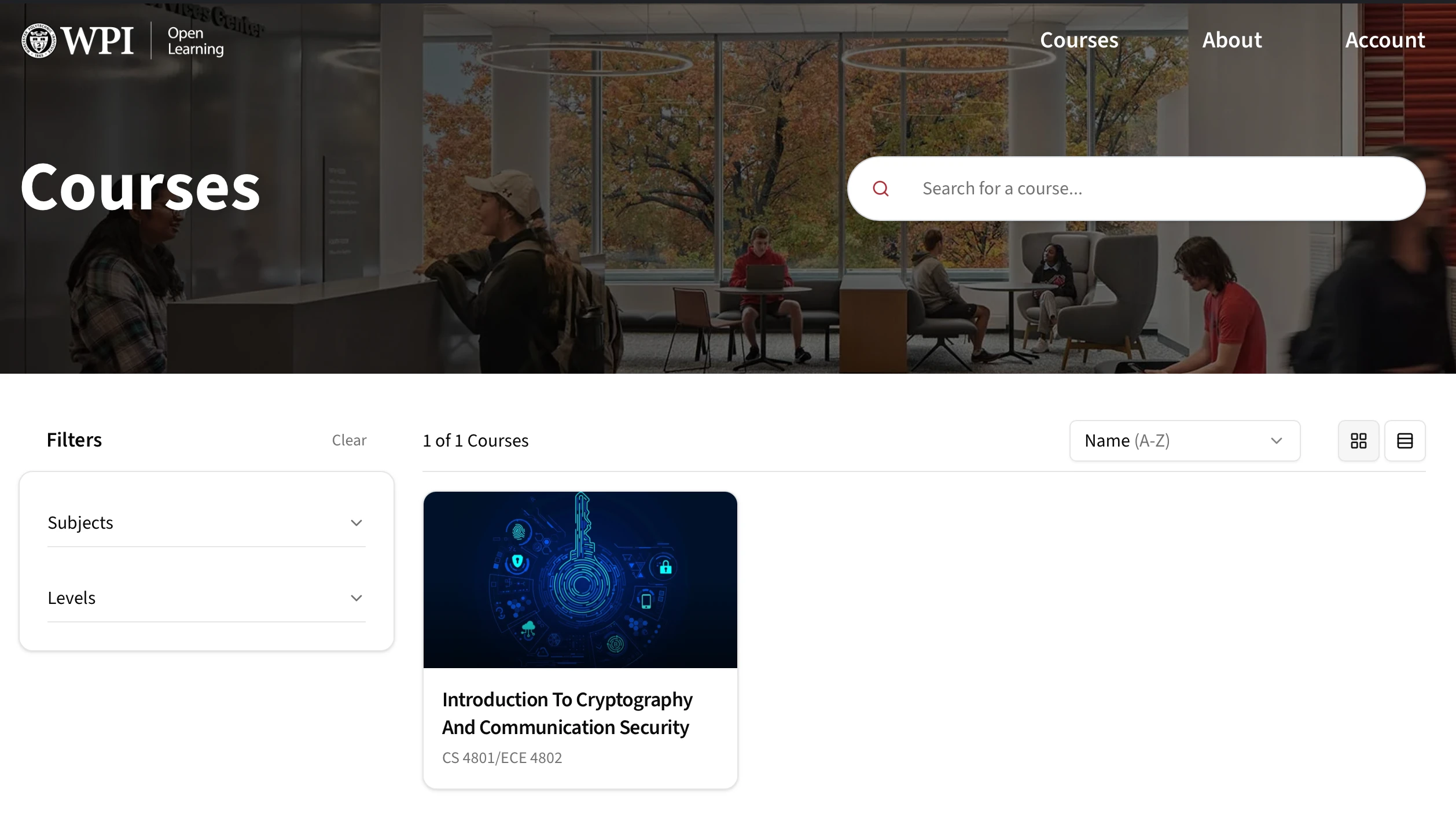
Below are some screenshots of the website:
Features
- Content: We provide a platform for WPI faculty to easily share and distribute course syllabi with students. Faculty independently upload and manage course content.
- Technology: Our technology enables faculty to easily migrate content from Canvas, the most widely used LMS in higher education, with flexible licensing and distribution options.
- Course Pages: Faculty can create unique pages for their courses.
- Licensing: Faculty can choose a Creative Commons license for their syllabi.
- Simplified Auditing: Administrators can audit courses for compliance and accreditation purposes.
If you are interested in using this technology at your institution, please contact me.
Technical Details
Unlike all my other projects, this one is not open-source. This website is operated by WPI, from their campus network, and the codebase remains proprietary under my copyright.
This project took nearly a year and a half to complete. I started it in the Fall of 2024, and after completing my Interactive Qualifying Project (IQP) in the Spring of 2025, I continued development of the site until the Spring of 2026. The website went through many revisions, both as the project requirements from the administration changed, and the technology stack evolved.
The website is built entirely in Next.js and does not use a traditional backend, opting instead for Next.js API routes and server actions, all written in TypeScript. We started with a Next.js frontend and traditional Express backend, but this quickly became a headache, as data had to be serialized into JSON and deserialized back into an appropriate type. This made type safety difficult to maintain, especially as the project constantly changed. For this reason, we migrated to the full Next.js stack, removing our Express backend entirely. The database is PostgreSQL, and the ORM is Prisma. All of the code is written in TypeScript, with Tailwind CSS for styling.
I was given full autonomy on this project from a technical standpoint. The administration didn't have any preferences for frontend styling, security, or networking. I was given a Linux VM and sudo perms and allowed to do whatever I wanted! I chose Apache web server as the reverse proxy, and configured my own security, backup, and networking rules.
Paper
As part of our Interactive Qualifying Project (IQP), my teammates and I wrote a paper about the project. We cover the importance of the project, including a clear need for the platform from faculty and student surveys. We also discuss the technical details of the platform, including the integration with Canvas, and overall system design. You can read it here. Note that the paper is outdated as both the project and the tehcnical details have evolved significantly since it was written.
This project would not be possible without the tremendous help of many individuals across WPI — from our project advisor, IQP team developers, the IT and ARC staff, and finally the administrative staff in the Dean of Undergraduate Studies office. Many universities wouldn't support a project like this, and I'm grateful folks at WPI did.